Deep Space Wonders: Dark Matter & Multiverse
Randhir Singh - Monday, 21 July 2025 | 02:25 PM (WIB)
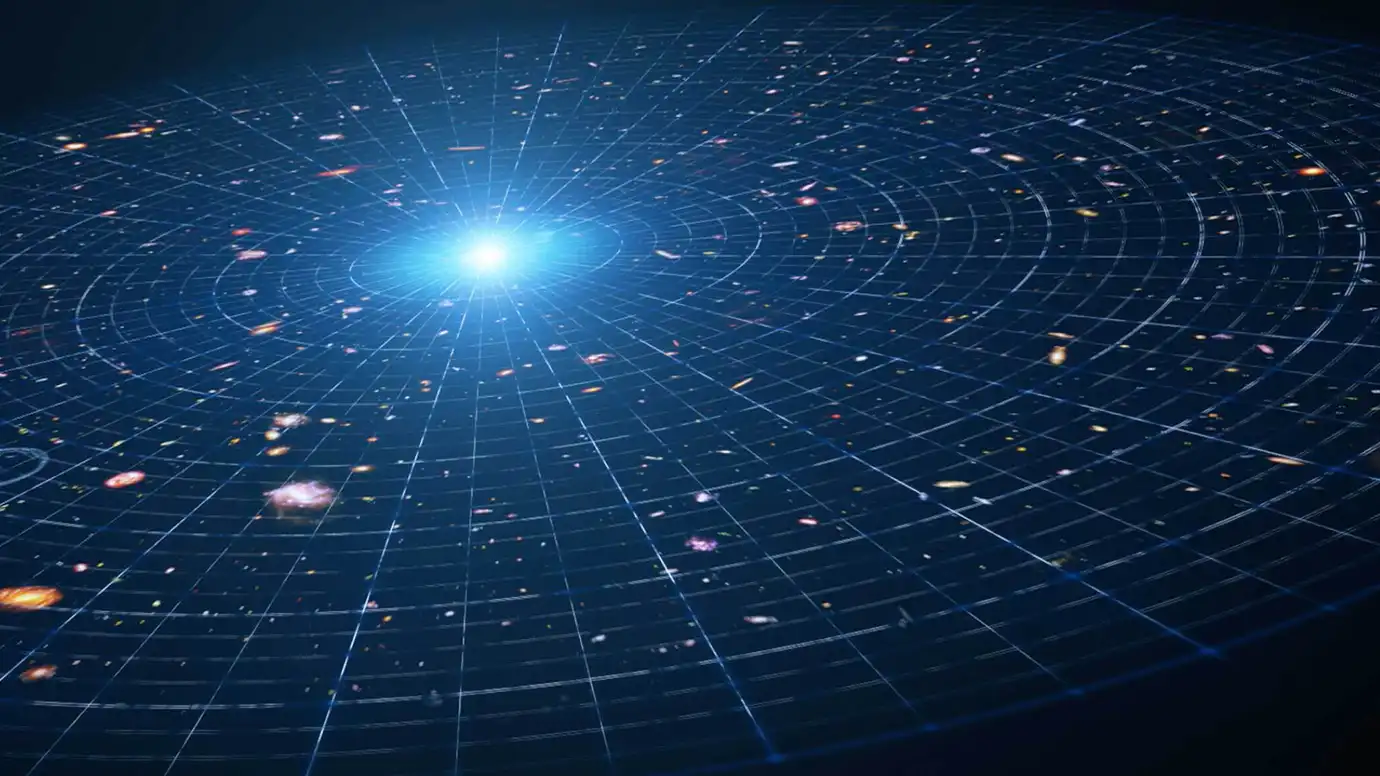
Beyond the Veil: Hunting for the Universe's Hidden Secrets
Ever gazed up at the night sky and felt that familiar tug of wonder, that overwhelming sense of "what else is out there?" If you’re anything like me, or pretty much anyone with a pulse, that feeling quickly morphs into a profound curiosity about the universe's deepest mysteries. We've come so far, mapping galaxies and probing black holes, yet two colossal puzzles continue to stump even the brightest minds on our planet: Dark Matter and the Multiverse. These aren't just abstract concepts for theoretical physicists; they’re the cosmic whodunit, the invisible forces and unseen realms that could entirely redefine our place in existence. And believe me, the chase is on.The Ghost in the Cosmic Machine: Unmasking Dark Matter
Imagine going to a party and seeing people dancing wildly, but you can't quite make out who's pulling the strings, who's leading the dance. That's a bit like our universe with dark matter. We see galaxies spinning at speeds that should tear them apart, light bending in ways that make no sense, and the cosmic web—the largest structure in the universe—holding together with an unseen glue. For decades, scientists have crunched the numbers, and the math just doesn't add up. About 85% of the universe's matter seems to be completely invisible to us, neither emitting nor reflecting light. It’s not just dark clouds of gas or regular black holes; it’s something else entirely. Call it the universe’s silent, gravitational superpower. So, if we can't see it, how do we know it's there? Think of it like a powerful wind you can't see, but you can certainly feel its push and see its effect on the trees. Dark matter's influence is undeniable. From the way individual galaxies rotate, far too fast to be held together by their visible stars alone, to the way entire galaxy clusters behave, and even the subtle patterns in the cosmic microwave background—the faint echo of the Big Bang—all point to a massive, invisible component. It’s the universe’s most elusive ingredient, and without it, our current understanding of cosmology just falls apart like a house of cards. The hunt for this invisible behemoth is intense. Scientists have cooked up various suspects for what dark matter could be. Could it be "WIMPs" (Weakly Interacting Massive Particles), hypothetical particles that barely interact with normal matter, making them incredibly difficult to detect? Or perhaps "axions," incredibly light particles that might subtly convert into photons in strong magnetic fields? Then there are the more exotic ideas, but the bottom line is we’re setting traps. Deep underground labs, shielded from cosmic rays, house ultra-sensitive detectors hoping to catch a stray WIMP or axion passing through. The Large Hadron Collider in Switzerland is trying to create these particles by smashing regular ones together at insane speeds. Telescopes are looking for indirect signs, like the faint gamma-ray glow that might appear if dark matter particles annihilate each other. It's a true scientific odyssey, and every new data point, every failed experiment, narrows down the possibilities, inching us closer to unveiling this cosmic ghost.A Universe of Universes? Peeking into the Multiverse
If dark matter is the universe's invisible friend, the multiverse theory is like discovering that your friend has an entire secret life, with a whole bunch of other friends you never knew existed. This idea, frankly, blows some people's minds. Forget just one vast cosmos; what if ours is merely one bubble in an infinite, frothing ocean of universes? It sounds like something straight out of a sci-fi blockbuster, right? But believe it or not, some of the most profound theories in physics actually suggest the multiverse isn't just possible, but perhaps even probable. There isn't just one "multiverse" concept; it's more like a family of wild ideas. One popular flavor comes from inflationary cosmology, which posits that immediately after the Big Bang, space expanded at an exponential rate. If this inflation never truly stops everywhere, it could continuously spawn new "bubble universes," each with its own physical laws, constants, and perhaps even dimensions. Then there’s the quantum multiverse, where every quantum possibility branches off into its own reality. And string theory, with its extra dimensions, also hints at a vast landscape of possible universes. It’s pretty wild stuff to wrap your head around, but physicists don't come up with these ideas just for fun; they're trying to explain some really perplexing observations. Why even entertain such a mind-boggling notion? One major driver is the "fine-tuning" problem. Our universe seems incredibly finely tuned for life to exist. If fundamental constants like the strength of gravity or the mass of an electron were even slightly different, stars wouldn't form, or atoms wouldn't hold together. It's like winning the cosmic lottery a billion times over. Some argue that this fine-tuning points to intelligent design, but another explanation, favored by many scientists, is that if there are countless other universes, then it's not surprising that at least one of them, ours, would have the right conditions for life. It's simply a matter of statistical probability. Probing the multiverse, though, is an entirely different ballgame from hunting dark matter. We can’t exactly send a probe to a neighboring universe, can we? Yet, scientists are theorizing ways we might find indirect "bruises" or "bumps" in our own universe that could be caused by collisions with other bubble universes. Think about subtle anomalies in the cosmic microwave background radiation – places where the "texture" of our universe might show signs of a past cosmic impact. It's incredibly speculative, requiring groundbreaking theoretical work and incredibly precise measurements of our cosmos. While direct detection remains a distant dream, the theoretical frameworks that lead to the multiverse continue to be explored, pushing the boundaries of what we thought was possible.The Grand Hunt Continues: What's Next?
So, where does all this leave us? We're living in an era of unprecedented scientific exploration, staring down cosmic enigmas that could completely rewrite our textbooks. The quest for dark matter is a tangible, experimental pursuit, with billions poured into detectors and colliders, hoping for that one elusive particle to register. The multiverse, while more rooted in theoretical physics, pushes our intellectual boundaries, forcing us to consider realities far grander than our everyday experience. The next few decades promise to be absolutely thrilling. As new telescopes come online, with capabilities we could only dream of a generation ago, and as detector technologies become even more sensitive, we might just be on the cusp of a breakthrough. Whether we finally snag a dark matter particle, or uncover some subtle, undeniable fingerprint of a neighboring universe, the implications will be profound. It's not just about adding another entry to a scientific paper; it's about fundamentally understanding what our universe is made of, and whether it stands alone or is just one in an infinite tapestry of realities. Humanity's insatiable curiosity is our greatest asset, and this grand hunt for the universe’s hidden secrets is the ultimate adventure.
Your Weekend Won't Recharge Itself: A Guide to Crushing the Energy Reset
a year ago

The Hidden Horrors of Tear Gas: More Than Just a Fleeting Sting
a year ago

1312: The Meaning, Origin, and Social Context of the Notorious Number
a year ago

The Digital Tightrope: How Social Media Puts a "Double Burden" on Today's Teens
a year ago

Say Goodbye to Awkward Texts: WhatsApp Unveils Your New AI Writing Coach
a year ago

The Secret Weapon of Penguins: Why Their Poop is More Impressive Than You Think
a year ago

NVIDIA Crushes New Record, Yet Market Concerns Still Exist Over "AI Bubble"
a year ago

Your Cosmic DNA? Unpacking How Zodiac Signs Shape Who We Are
a year ago

The Siren Song of Easy Money: Why We Can't Resist
a year ago

Unplug and Recharge: Your Guide to Escaping the Gadget Grip
a year ago